
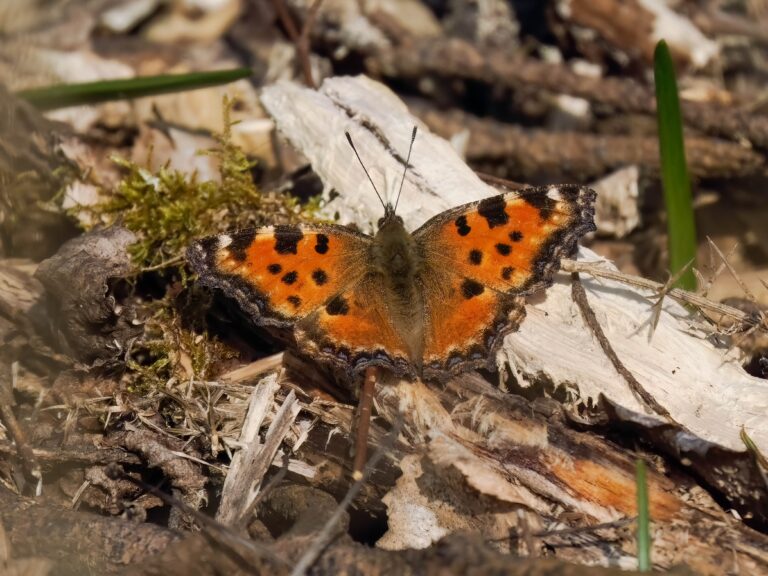
‘Extinct’ butterfly seen across England in suspected de-extinction process
A butterfly classed as extinct in the UK for more than 30 years was recently seen at sites across southern England.
Eagle-eyed nature lovers have captured photographs of Large Tortoiseshells in Kent, Hampshire, Sussex, Dorset, Cornwall and the Isle of Wight in the past two weeks.
Although there have been rare sightings over the years since it went extinct, they are becoming increasingly common.
The charity, Butterfly Conservation, is now saying that if it were to update its official endangered species list tomorrow then it would probably class the Large Tortoiseshell as no longer extinct.

‘This is great news about a beautiful and charismatic butterfly,’ says Professor Richard Fox, Head of Science at Butterfly Conservation.
‘If the individuals that are being seen can survive and reproduce then there’s no downside to the Large Tortoiseshell coming back, and we can look at what we might be able to do to help it.’
The Large Tortoiseshell is a big, colourful butterfly with orange, black and blue wings. Experts say it’s closely-related to the Small Tortoiseshell but has different markings.
The species was once found across England and Wales, but was last recorded as a resident, breeding species in the UK in the 1980s.
Adults primarily lay their eggs on elm trees and the population crash was linked to the spread of Dutch elm disease across Europe in the 20th century.
‘Reasonable to assume that the species is now established’
Butterfly lovers have excitedly reported sightings of individual Large Tortoiseshells over the decades, but there has never been evidence of a stable breeding population which would allow ecologists to classify it as a ‘resident species.’
In recent years, however, there has been significant growth in the Large Tortoiseshell population in the Netherlands, and ecologists now think an increasing number might be flying across the sea to England.
The Large Tortoiseshell emerges from hibernation on the first warm days of spring, which is why lepidopterists have been reporting sightings in the past two weeks, at a time when there are few other butterflies on the wing.
Last week saw the Butterfly Conservation team adding the species to its First Sightings web page which records the first dates and locations reported for all UK species.
This year’s first reported sighting of Large Tortoiseshell was on the Isle of Wight on 24 February.
Members of public have also reported at least 20 more sightings on the Isle of Wight, in Kent and Hampshire, and Butterfly Conservation’s Sussex Branch members have reported a string of sightings in their county.
The species is officially classed as ‘regionally extinct’ in Great Britain on Butterfly Conservation’s GB Butterfly Red List which was last updated in 2022.
The report also noted that ‘possible recent colonisation in southern England has not been included yet in the assessment.’ Experts say the assessment may change when the next Red List assessment is made in a few years’ time.
‘We’re in that wait-and-see phase’
‘I would imagine that, if things carry on with this trajectory, then when we compile our next GB Red List we not classify the Large Tortoiseshell as regionally extinct,’ says Professor Fox.
‘I think it’s reasonable to assume that the species is now established in several parts of Britain.’
As and when the charity makes that decision, it will officially have a new resident British butterfly on its books.
‘When a new species colonises, there is a period of uncertainty: many species that colonise take off and become common but some remain highly localised and can even then be lost; at the moment, for Large Tortoiseshell, we’re in that wait-and-see phase.’
Breaktime News recently reported on a significant rise in numbers for one of the UK’s rarest butterflies, the heath fritillary.
