
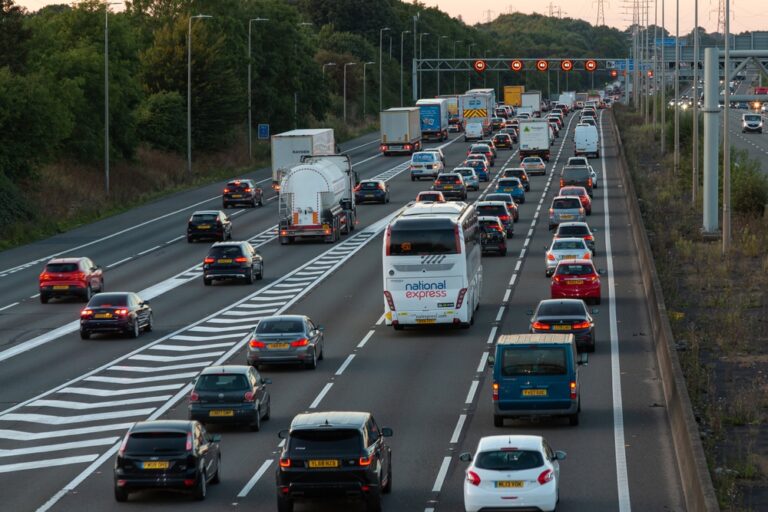
AA says congestion and road condition are key issues for drivers
The UK’s first full-length motorway turns 65 this month. The MI opened in 1959 and the AA recently surveyed more than 10,000 motorists about their impressions of the state of our roads.
More than 7000 of the respondents had driven on the M1. They were asked for feedback on key areas, including congestion, road condition, road markings, signage, lighting, quality of service areas – and litter.
Some 60% of these drivers said that congestion is poor with a third of them saying that the road condition is poor. On the upside, nearly half of those who took part (48%) think the signage is excellent.
The first stretch opened between Watford and Rugby and was billed as the London to Birmingham motorway. Despite poor weather conditions, it only took 19 months to construct – a key feat as 1958 was one of the wettest summers on record.

The M1 now runs for 193 miles linking London to Leeds. It was constructed in four phases with the final part opening in 1999. It quickly established itself as the North / South gateway.
Prior to the construction of the UKs motorway network, drivers relied on a series of A roads which went through towns and villages, these were often single carriageway and very often congested.
The early M1 had no speed limit, crash barriers or lights. It also had soft verges rather than hard shoulders. During the first year, 20,000 motorists used the M1 each day – today it’s between 130,000 and 140,000 a day.

Image: Jevanto Productions / Shutterstock.
M1 construction = easier North to South delivery routes
‘The M1 has been the backbone of British motoring for 65 years. Whilst it has its issues, people forget or don’t realise what it was like before our major motorways were constructed,’ says Edmund King, AA President.
‘The construction of the M1 led to more freight moving to road enabling easier North to South delivery routes.’
‘Major towns and cities were congested, and journey times were much higher than they are today. However, more than half of motorists said congestion on the M1 is a major issue for them.’
‘The M1 transformed mobility in the UK – it enabled families to visit relatives in far-flung parts of the country which would have taken many more hours to get to and led to the expansion of motorway network we recognise today.’
Around 14,000 drivers were assisted on the M1 in its first year of operation by a special fleet of AA Land Rover patrols co-ordinated from a special Mobile Operations Centre at Newport Pagnell.
Last year, the organisation attended 15,000 call outs on the motorway. It says the main causes of call out haven’t changed in the last 65 years. Issues have included: engine trouble, tyre problems and flat batteries.
In 2009, the first section was converted to a Smart Motorway operation (between Luton South and the M25). The organisations says 120 miles is now subject to some form of smart motorway rules.
Motorway development leading to service areas
The AA has had severe reservations about smart motorways from the beginning – and 81% of members want to see them scrapped.
Recently unearthed footage filmed by the AA around the opening has been married with current day footage to give an idea of how the M1 has changed over the last 65 years.
With the development of motorways, came the advent of the motorway service area – the first were at Newport Pagnell and what is now known as Watford Gap (previously Blue Boar).
Dozens of famous people stopped at the 24 hour restaurant, including The Beatles and Rolling Stones whilst they toured the UK. There are currently 12 service areas on the M1.