
Conservation charity launches Festival of Blossom
The wintery rain is (finally) giving way to some much needed sunshine for all of us. Garden experts are today saying the wet weather along with changing temperature changes means a potentially good start to blossom season.
That’s the conclusion from the National Trust which maintains more than 220 gardens. Its’ experts say last week’s dramatic jump in sunshine and temperatures will be helpful for plants and flowers. Aberystwyth enjoyed a high of 20.9C on Wednesday.
‘Last week’s warmer days were a short, welcome change!’ says Dave Bouch, Head Gardener at Cotehele in Cornwall which is home to 12 acres of orchards. He says the return of average temperatures contains a silver lining.
‘But now temperatures have dropped back to 10-12 degrees here, with chilly nights. This will slow the progress of blossom, meaning we can enjoy it for a bit longer.”

And while this week’s return to cooler, cloudier days may feel disappointing, it should help extend blossom displays in the coming days and weeks.
‘Spring can be fickle,’ explains Sheila Das, The National Trust’s Head of Gardens and Parks.
‘What we need now are stable days – no high winds or sharp frosts that could damage tender seedlings and blossom – and steady spring temperatures to help the plants get growing for the season ahead.’
The predictions come as blossom begins its sweep up the country – from the south-west to the northernmost tips of Scotland.

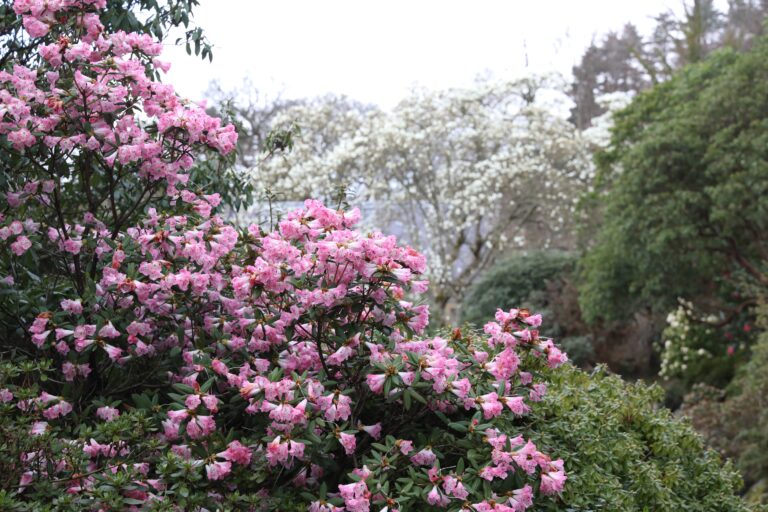
Bodnant Garden with the sunshine illuminating Magnolia campbellii. Image: Lucy Bidgood / National Trust.
‘There is something comforting about the cycle of gardens’
The National Trust is launching its Festival of Blossom which aims to inspire people of all ages to notice nature at its places and beyond.
The festival will include poetry, storytelling, new blossom walks and ‘playful pavilions’ in London, Manchester and the north-east of England.
The event culminates in the Big Blooming Break from 20 April through to 3 May which invites people to ‘take a breather in Blossom this spring.’
‘It’s easy to feel disconnected from nature, especially in built up environments. But whatever is going on in your life or the wider world, the first blossom is a real beacon of joy and hope!’
‘It reminds us that the rhythms of the natural world are going on all around us – in our parks, on our streets, in Trust gardens and countryside, and in our own backyards.’
‘Taking a moment to appreciate blossom is guaranteed to lift your mood, whether on the walk to work or school, or at one of the blossom events we’re taking into cities this spring.’
At Nymans in West Sussex, Head Gardener Joe Whelan agreed the recent sequence of conditions would be soaked up by spring blooming plants.
‘For ideal blossoming conditions, you want it sunny, but not too hot – low teens is ideal. The rhododendrons are amazing now, a benefit of months of rainfall. What we’ve been lacking, until last week, has been sunshine to really get things to open and show.’
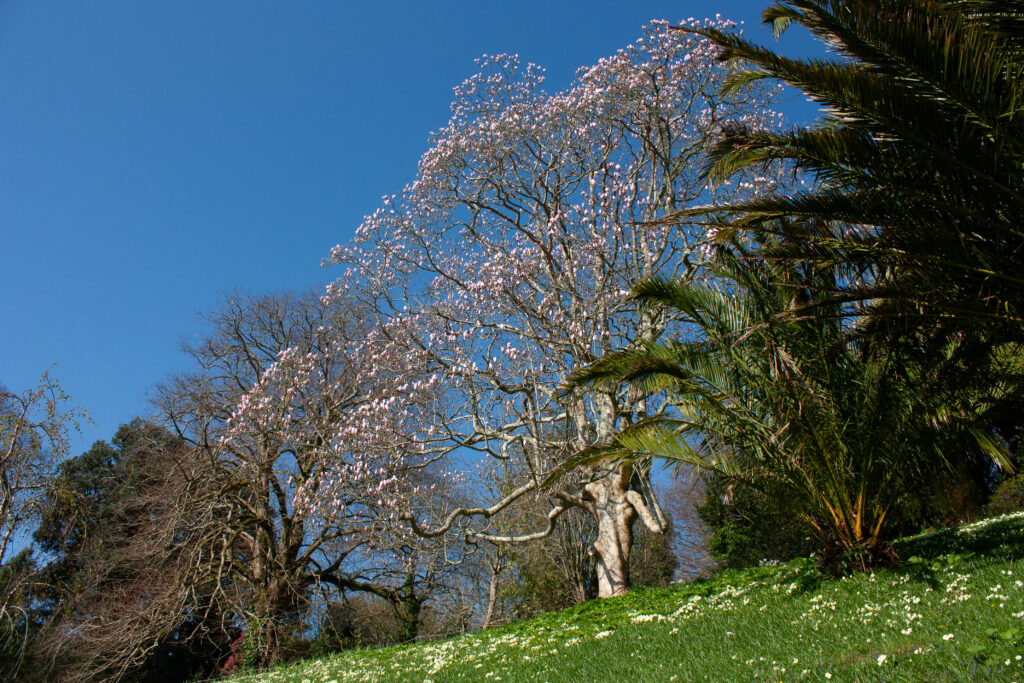
Magnolia in Glendurgan Garden, Cornwall. Image: Harriet Whitby / National Trust
‘I think it will be a bumper season ahead’
The fluctuating temperatures have produced a mixed year for magnolias. But the garden’s scented, pink-tinged ‘Leonard Messel’ magnolias – a popular cultivar bred at the garden in the 1950s – are at their best now.
Joe thinks it will be a good year for the garden’s cherries, which have ‘loads of buds.’
A particularly beautiful example is the more than 60-years-old weeping Prunus pendula ‘Pendula Rosea’ (drooping rosebud cherry) in the walled garden – which sped into bloom thanks to the lift in temperatures last week.
This’ll be followed by a group of Prunus Tai-haku which typically produce their pure white blossom from early to mid-April. The fruit blossom at Mount Stewart, County Down, takes longer to arrive.
Thanks to its microclimate, the garden can grow kiwi fruit, and the vines in Lily Wood and the Sunk Garden produce bright orange, yellow-centred blossom in the middle to later parts of summer. The kiwi jam made by the garden’s creator was renowned!
Now, the magnolias and rhododendrons are shining, especially the garden’s three impressive Magnolia grandiflora, pink-flowered Rhododendron magnificum (the oldest tree of its kind outside of its native range) and scarlet Rhododendron arboreum.
‘I think we’re in for a good season, everything is bursting with buds and flowers,’ says Robert Wilson, Assistant Head Gardener.
‘It’s been a very wet season, but also very mild, and we’ve only had one keen frost. I think it will be a bumper season ahead.’
‘Blossom brings positivity’
Cornwall’s Glendurgan enjoyed five consecutive days of sunshine last week – with temperatures reaching up to 15 degrees.
The warmth coaxed out smaller-flowered magnolias such as Magnolia x soulangeana at Glendurgan and Trelissick, as well as the large ‘Peter Veitch’ magnolia which stands above the historic maze at Glendurgan.
‘It felt like quite a jump, after a damp, cold winter. It was our first steady sunny period in months,’ says Adam Carveth, Head Gardener for the Heart of Cornwall Portfolio.
Cherry blossom is susceptible to wind, and magnolia blossom can be scorched, so what’s needed now is a period of calm weather.
‘Sometimes we do get an April storm, but I hope we’re going into a more settled period now when the blossom can really shine.’
Dyrham Park, near Bath, got spring underway with apricot ‘Goldcot’ whose white blossoms were coaxed out by its sheltered position in Fountain Court.
‘It’s so covered in blossom that it almost looks fake,’ says Garden & Outdoors Manager Piers Horry. ‘Thanks to the warm, wet and frost-free conditions, some tulips are out which wouldn’t normally be expected before Easter and fruit buds are breaking.’
‘Wild cherries are bringing flashes of pink and white to the landscape now and full flowering is imminent, a few weeks early.’
‘The blossom lifts your mood’
He expects the apple espaliers and perry orchard to flower in May, but doubts we will see a second flush of blossom, which some trees can produce, due to the stress of last year’s extended dry spells.
Nearly 240 miles north, at Gibside, Gateshead, another apricot, ‘Moorpark’, is heralding spring.
‘Spring is so dynamic – one day there’s no blossom, the next day we’re bursting into flower,’ says Head Gardener, Cail Stewart who says tree blossom is on track, with buds swelling and pollinators emerging.
‘We had nearly a week of double figures and got used to having warmth in the air, then we had an unexpectedly hard frost.’
Cail hand-pollinates early flowering stone fruit like the apricot, which involves ‘tickling’ the blossoms with a soft brush to transfer the pollen from the male to the female part of the flower, mimicking what a bee does when it forages.
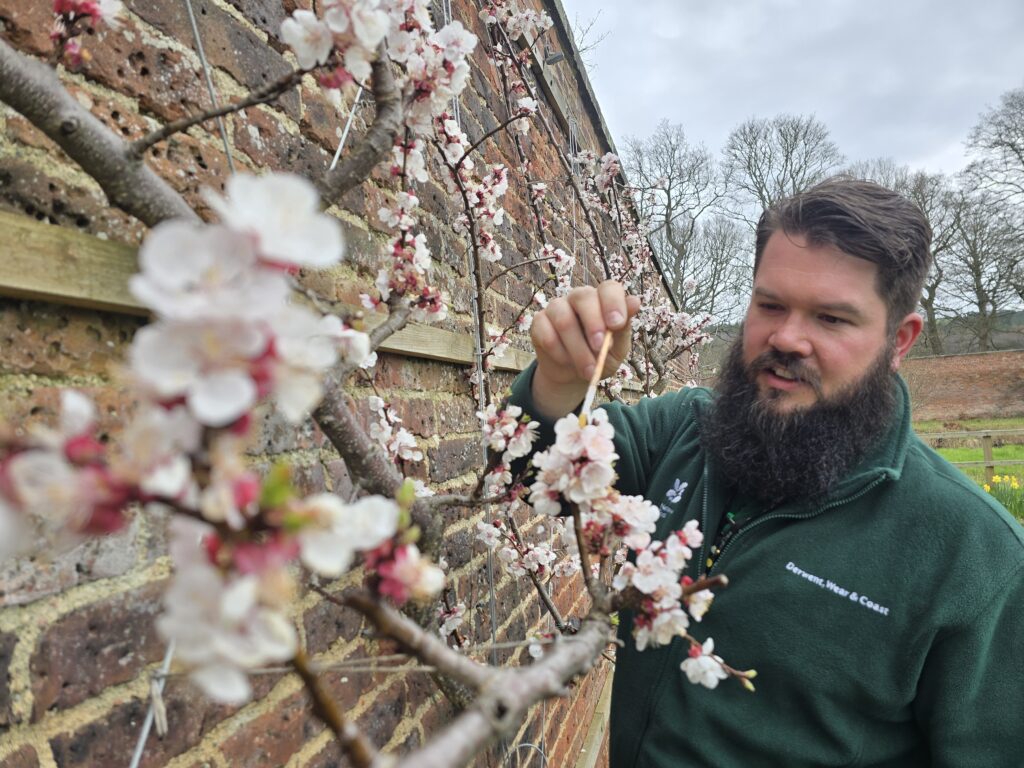
Gibside’s Head Gardener, Cail Stewart, hand-pollinates apricot blossom. Image: Ashleigh Watson / National Trust.
The Georgian landscape garden’s apple avenue usually burst into flower around mid-April, alongside plums, gages and Morello cherries. This year, Cail thinks the blossom will arrive about a week earlier.
‘It’s not really about timing, it’s about conditions. Will there be a frost? Will a storm blow buds or flowers off? There’s nothing like this in the forecast. Rainfall has got things started, warmth in the air will see things budding up and pushing on.’
In Wales, Ned Lomax, Head Gardener at Bodnant Garden, is optimistic that the recent stable, wet months will deliver impactful displays at the Conwy garden.
‘So much spring flowering here’
‘Unlike some years, when we have seen the temperature vary by 15 degrees in one day, the build-up to this spring hasn’t brought huge fluctuations.’
‘We’ve had a gradual, consistent increase in temperature and it has rained most days. On the whole, that’s good for flowering.’
A recent hard frost caught some magnolias but there are plenty of buds still to come, there are lots of camellias in full flower, and trained Japanese quinces on the Lily Terrace are blossoming well. The rhododendrons are also ramping up.
‘A small number of rhododendrons ‘false flowered’ in autumn, meaning they won’t flower this spring. But there is so much spring flowering here that it won’t be noticeable.’
A particular blossom highlight is the group of Japanese ornamental cherries in the small arboretum between the shrub borders and Old Park, which should reach a peak in late April into early May.
‘Blossom brings positivity. We’ve been through a long winter, so to work in a tee-shirt, feel the sun on your back and see the blossom lifts your mood. There is something comforting about the cycle of gardens – there’s always something to look forward to.’
Breaktime News has previously reported on The National Trust’s launch of its ‘Big Blooming Break’ project to encourage more people to enjoy their outdoor surroundings – and marvel at the magic of nature.