
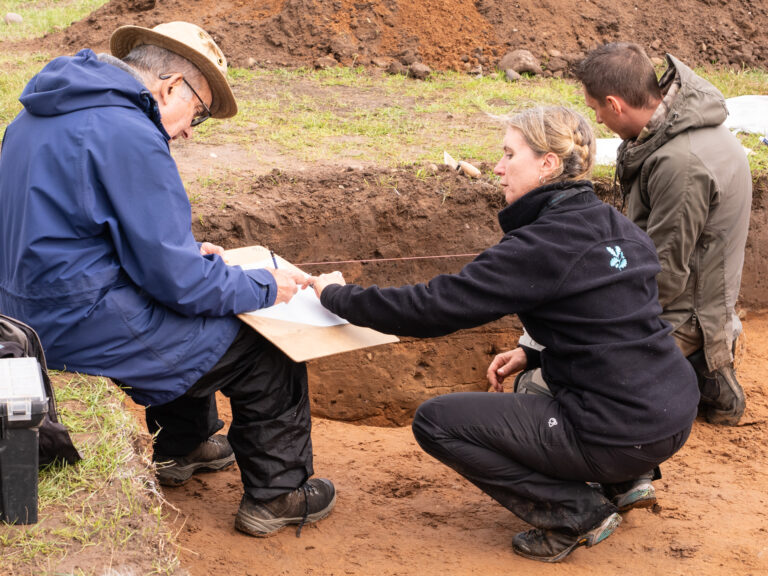
Excavation uncovers past secrets of everyday life
Experts say they’re gaining ‘remarkable insights’ into the day to day lives of people who lived on the fringes of Shropshire’s Wroxter Roman City.
In Roman standards, it was a colossal settlement and was once the fourth largest city in Roman Britain. Parts of the site are open to the public which can explore the remains of the city centre and even see what it’s public bath house would have looked like.
The National Trust recently announced it was undertaking a ‘landmark geophysical survey’ of the area. Experts had identified significant archaeological features including Roman villas, cemeteries and roads. They had even found Iron Age farmsteads.
The recent excavation work’s led to a number of discoveries, including a 2,000-year-old hand-decorated incense bowl.

The charity says it was found at the heart of what is believed to be a Roman shrine. It adds that the piece offers a rare and intimate connection to the spiritual practices of the time.
Over two weeks in September, archaeologists worked alongside volunteers and members of the public to explore three trenches and several test pits.
The excavation revealed an Iron Age roundhouse, a Roman industrial complex and the shrine itself.
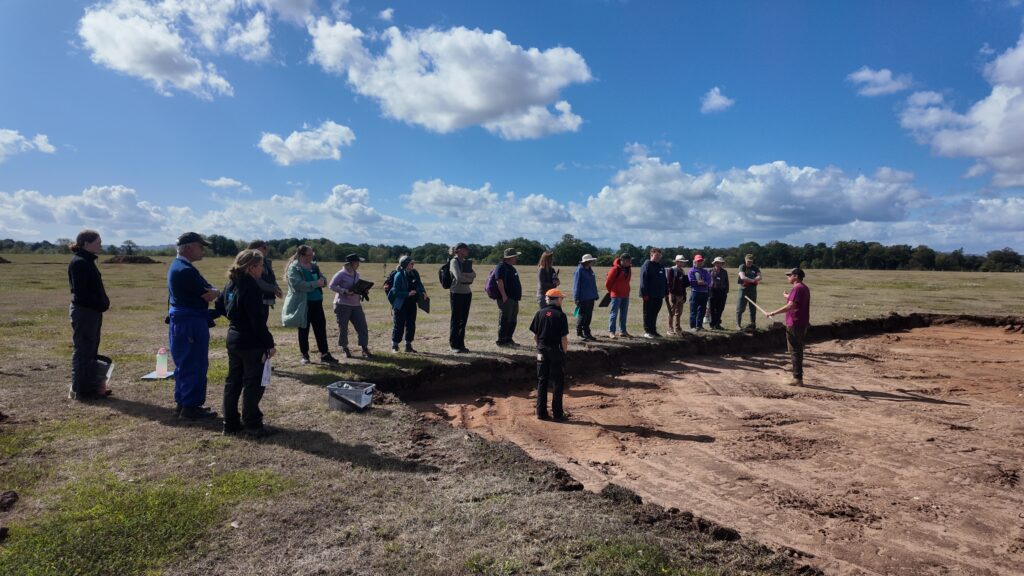
Participants in Attingham Unearthed. Image: Victoria Bounds, National Trust.
Attingham Unearthed: a new model for archaeological research
This year, the National Trust launched ‘Attingham Unearthed’, to test a new model for archaeological research.
The aim is to create hands-on, sustainable archaeology experiences for the public, alongside experts, with the potential to offer the same at other Trust sites.
Attingham was chosen for its rich archaeological landscape, spanning prehistory to the post-medieval period.
‘This pilot project marks an exciting new approach for the Trust,’ says Mark Agnew, General Manager of the Attingham Estate.
‘For the first time, visitors could book a place to dig alongside archaeologists who have been testing the results of the geophysical survey and ensuring our nature recovery ambitions work in harmony with our hidden heritage.’
‘The work aims not only to connect people with the past, but also to deepen understanding of the wider history of Attingham Estate.’
‘What makes this project so innovative is its hands-on, sustainable approach. It transforms traditional excavation into a shared experience that supports research, conservation, and public participation.’
The excavation, on tenanted farmland on the Attingham Estate, unearthed a rich array of artefacts that bring Roman life into the present.
Discoveries included a piece from an incense bowl – hand decorated and found within a shrine enclosure.
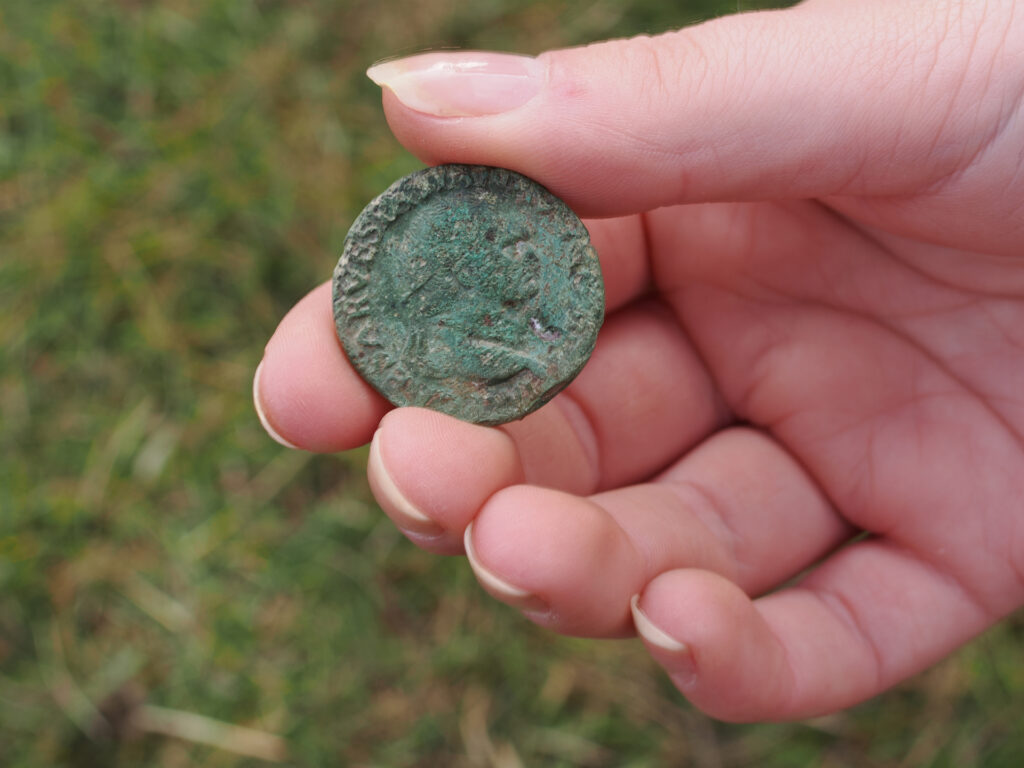
Roman coin of the Emperor Vespasian (dated 71 AD). Image: Jane Gough, National Trust.
‘Ritual and remembrance’
Experts say it’s a deeply personal artefact which points to ‘ritual and remembrance.’ They add that it shows how spiritual life was practiced on the city’s edge and how craftsmanship carried meaning.
They also uncovered a metal acorn which is likely to be a decorative feature from a Roman furniture item such as a small box.
In Roman culture, the acorn symbolised fertility, strength, and the origins of life. Its presence suggests domestic comfort and symbolic expression even in utilitarian objects.
Teams also came across a ceramic object which is believed to be the base of a candlestick.
They theorise that its presence suggests work and home life may have been closely intertwined on the site – and that light and warmth were part of everyday routines.
Excavations revealed a well preserved metal helmet handle which is believed to be part of Roman military gear. It offers a tangible link to the soldiers who once occupied the region.
Its identification is supported by comparative research, and it may have belonged to a soldier stationed at Wroxeter during the early phases of Roman expansion.
And then there’s a Roman coin which is believed to date to around 150 BC (that’s before the Roman occupation of Britain).
It’s thought it may have travelled across Europe with a soldier or trader and offers clues about long-distance movement and personal possessions in the Roman world.
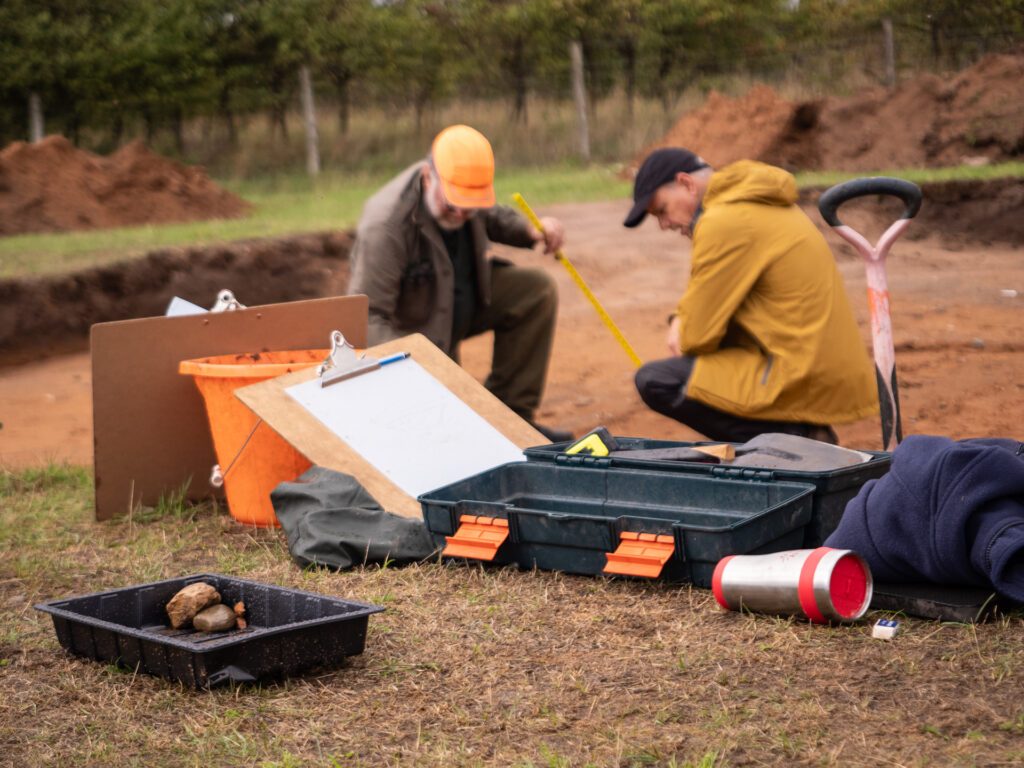
Participants of Attingham Unearthed. Image: Jayne Gough, National Trust.
‘The dig may have been small in scale, but its impact is enormous’
Other investigations prior to the September dig included a supervised, systematic metal detecting survey across all archaeologically significant areas of the estate.
Carried out by Newport Heritage Society in partnership with the National Trust, this uncovered a ring key, a clever combination of a piece of jewellery with a working key, often used to secure small boxes or personal items.
These objects were both practical and symbolic, reflecting the wearer’s status and their ability to safeguard valuables.
During the excavation, volunteers and archaeologists worked alongside Matt Williams, a Time Team archaeologist, and Dr Roger White, the leading expert on Wroxeter Roman City and its hinterland.
Schools, youth groups, and local community organisations also took part in activities, ranging from surveying and washing finds to guided tours and test pit excavations.
The evaluation of the experiences of those that took part is being undertaken by Professor Carenza Lewis.
‘It is always a great pleasure to work with enthusiastic diggers and to share in the excitement of discovery,’ says Dr White.
‘This fortnight has made a significant, and important, contribution to our understanding of Wroxeter and its immediate surroundings. The dig may have been small in scale, but its impact is enormous.’
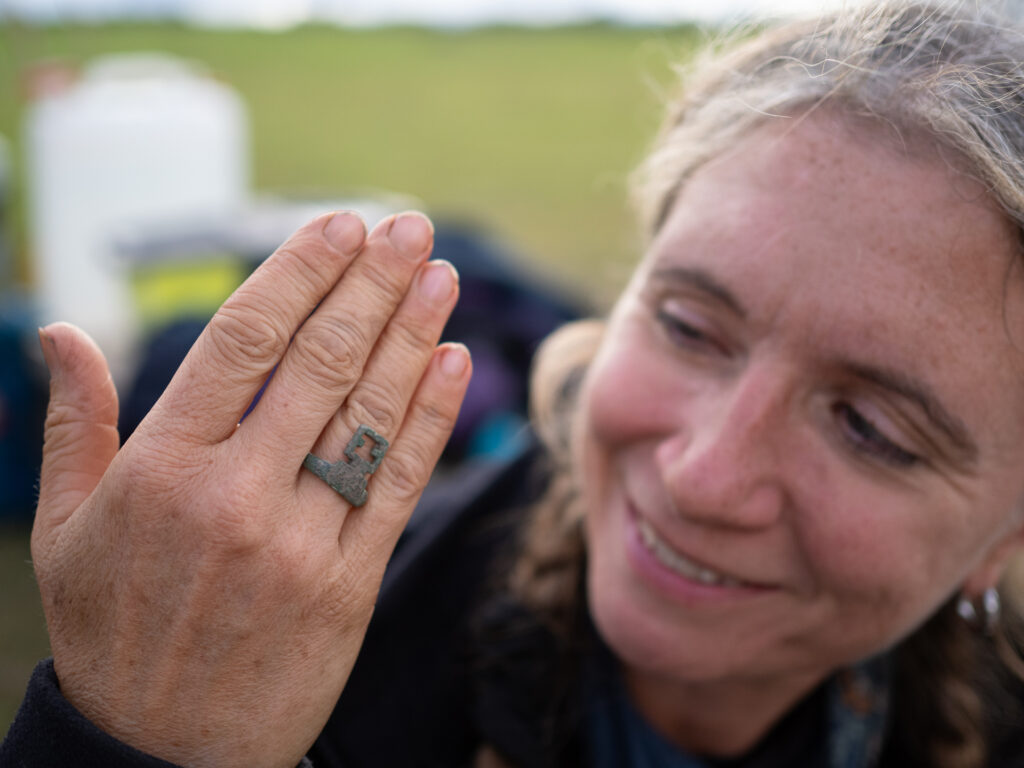
Roman ring key. Image: Jayne Gough, National Trust.
‘A unique chance to explore how ordinary lives played out’
‘Attingham Unearthed’ offers a unique chance to explore how ordinary lives played out in the shadow of one of Roman Britain’s great cities,’ explains Suzy Watts, National Trust Archaeological Project Manager for ‘Attingham Unearthed.’
‘It also shows how archaeology supports wellbeing, from the simple act of being outdoors to the sense of purpose that comes with discovery.’
‘This has been more than an archaeological excavation. It has been a community collaboration.’
‘What we have learned from the people who took part, and what they enjoyed, will shape how we uncover and share hidden histories across other Trust places.’
The objects found during the excavation will be on display to the public in 2026.
Breaktime News recently reported on an appeal to try to protect Castilly Henge, near Bodmin. The site is believed to date from 3000 to 2500 BCE.
