
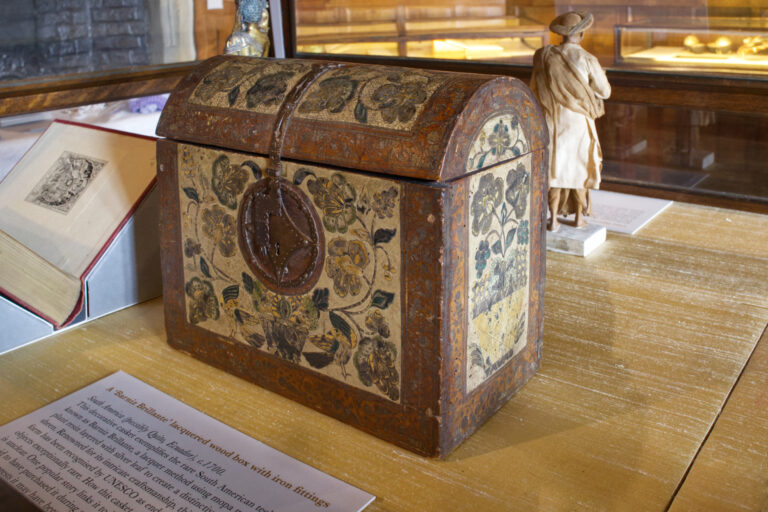
Small casket becomes central to exhibition
A small wooden box which may have been a holiday souvenir either brought back by Rudyard Kipling, or given to him as a gift by his daughter, has turned out to be a very rare handmade South American casket.
Although seen for many years by visitors to his home, Bateman’s at Burwash in East Sussex, it has only just been recognised by National Trust curators as being created using techniques from South America – known as Barniz de Pasto.
The ancient practice involves applying thin layers of coloured resin extracted from the seeds of the mopa mopa shrub to create beautiful decorations.
The craft is still practised in modern day Columbia but was inscribed in 2020 to UNESCO’s list of Intangible Cultural Heritage in Need of Urgent Safeguarding.

National Trust curator Dr Megan Wheeler identified the casket which has been on show to visitors in the Parlour Room of Bateman’s and is now one of the key exhibits in a new Kipling Exhibition at the house.
The exhibition explores Kipling’s life through his writing, his family and many of the objects he left at his beloved Batemans.
He started his writing career while working in India, where he was born and his extensive travels to many other parts of the world are explored as part of the exhibition.
Many of the objects in the exhibition relate to his travels but the casket turned out to be particularly unusual.
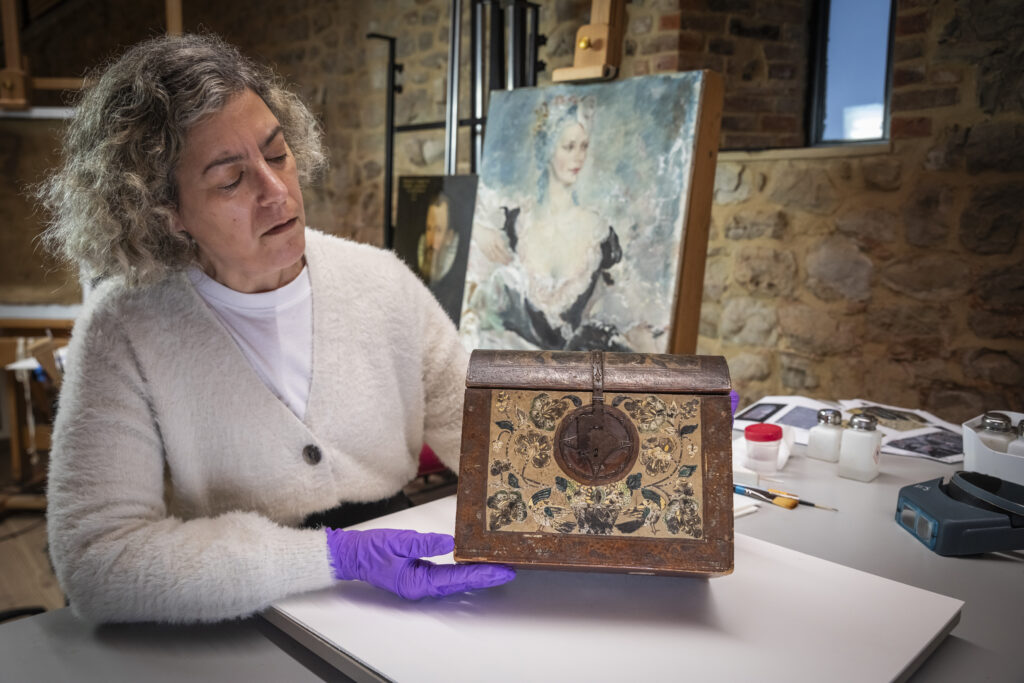
A conservator inspecting the Barniz de Pasto casket. Image: James Dobson / The National Trust.
A mystery: how did the casket came into the Kipling household?
‘Prompted by the knowledge that our counterparts at the V&A were working on the Barniz de Pasto objects in their collection, we looked carefully at our own and so were able to correctly identify this wonderful piece at Bateman’s,’ explains Dr Megan Wheeler.
‘These Barniz de Pasto objects are very rare and as a result are often miscatalogued as ‘lacquer work’: the earliest record we have for this item simply described it as an ‘old Spanish wood casket.’’
It is thought to date to around 1700. As well as layers of resin the Bateman’s casket has a layer of silver leaf as part of the decoration in a technique known as Barniz Brillante.
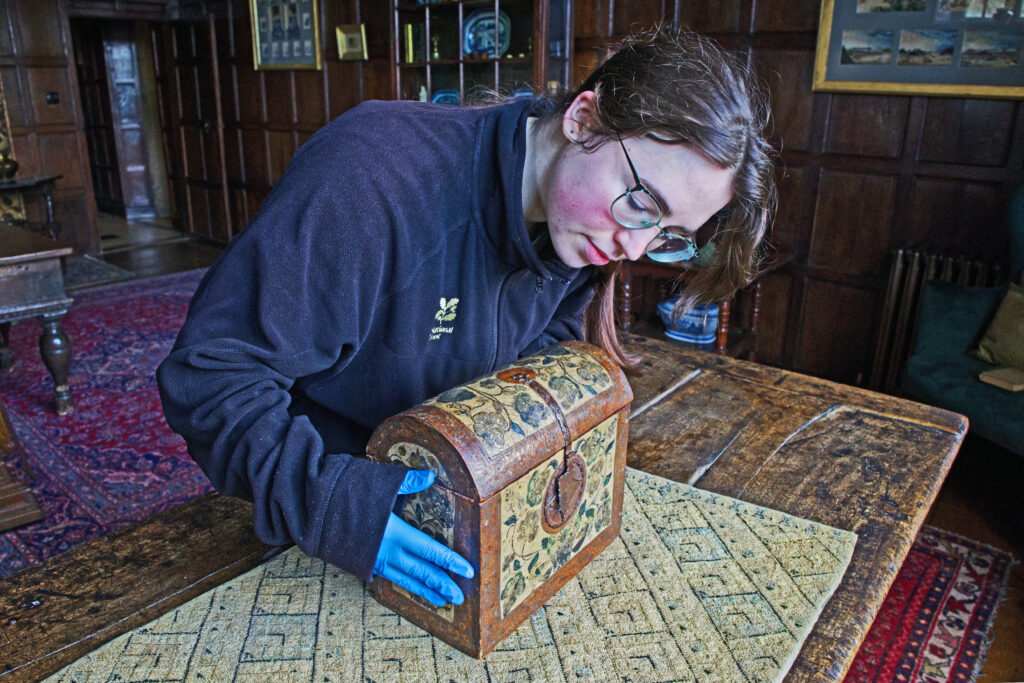
The Barniz de Pasto casket being put on display at Bateman’s. Image: Laurence Perry / The National Trust.
The decoration has similarities to other objects but they are so rarely studied that it is not possible yet to narrow down which town, or even country it might have been crafted in.
Despite extensive searches of archives, there remains some mystery about how the casket came into the Kipling household.
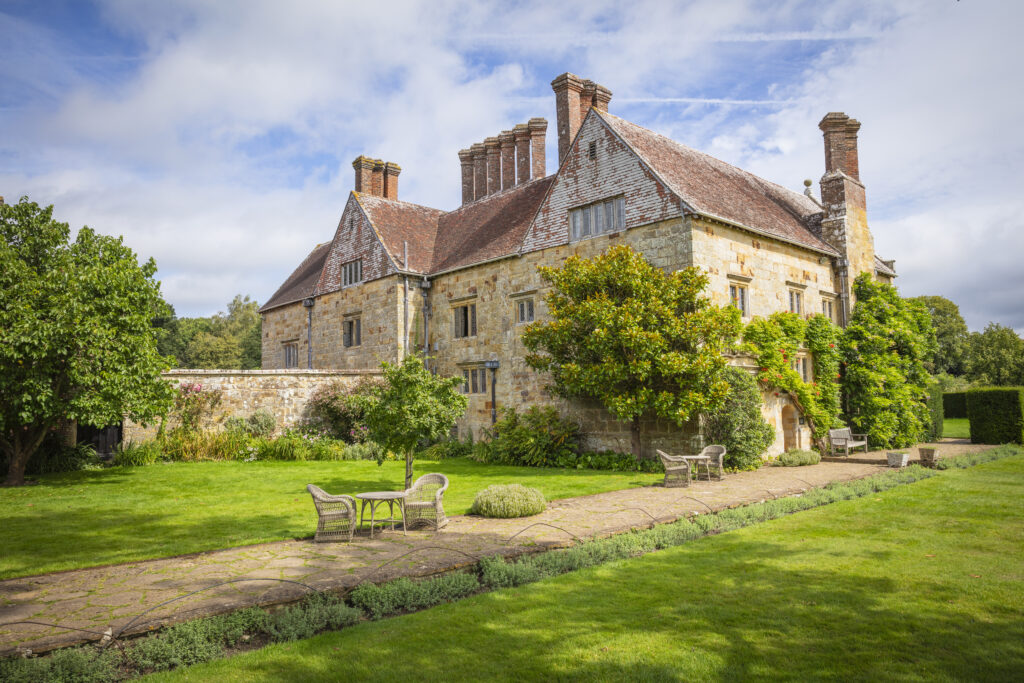
One option is that it was a gift from his daughter Elsie bought on honeymoon in Spain. Or it may have been bought by Kipling while on his trip to Brazil in 1927.
Born in India, Kipling was very well travelled, visiting Hong Kong and Japan, through the USA and South Africa as well as South America.
He regularly purchased objects on his travels, bringing them home to become part of the furnishings at Bateman’s.
There are gaps in his surviving archived papers and no record has yet been found of when the casket was bought.
Using non invasive techniques to ‘find out as much as we could’
Once identified, the casket was sent to The National Trust’s Royal Oak Foundation Conservation Studio in Kent for detailed analysis and study, as well as cleaning, working with the V&A who have some experience of similar objects in their collection.
‘We wanted to use non-invasive techniques to find out as much as we could about the casket,’ says Emma Schmuecker, Head of the Conservation Studio.
‘It is the first time that a Barniz de Pasto item has been put through such a detailed study and the information will be valuable for future scientific study of these objects.’
‘It could help us create a timeline for when pieces were made and even, with sufficient examples, identify individual workshops.’
The analysis involved high resolution digital microscope study, infrared photography and scanning X-ray fluorescence which identified the chemical composition of the casket’s surface.
The study shows the box is likely made from Spanish cedar held together by pegs made from bamboo.
To apply the resin the wood is cross-hatched and the resin is heated and pressed onto the wood by hand, often leaving the fingerprints of the makers.
The resin was dyed and the craftspeople would carve through the multiple coloured layers to build up the complex patterns.
‘The casket exemplifies the complexity of global trade’
Some of the analysis shows chemicals which are likely to have been used to kill woodworm or other pests and there is some damage showing sign of previous woodworm infestation.
‘We believe this piece would have been commissioned from local artisans, probably by Spanish noblemen or clergy,’ says Emma.
‘The shape of the casket and some of its decoration were clearly derived from East Asian lacquered objects, whilst the fruits and flowers are South American in inspiration.’
‘Other elements, like the use of silver leaf, reflect the influence of the Spanish who colonised that area of South America.’
‘The casket exemplifies the complexity of global trade and exchange in the early modern period.’
‘It is no surprise that this delightful little casket appealed to Kipling – very much a man of the British Empire – whose tastes were shaped by, and reflected, his travels.’
The casket has gone on display in the exhibition at Bateman’s, exploring the life, work, and legacy of Rudyard Kipling through a variety of items connected to his life.
Among the other rare objects on display are a finely crafted Japanese handscroll from the early Edo period, a model of a seal made from sealskin, likely acquired by Kipling during his 1907 Canadian tour.
There is a toy pig gifted by Kipling to his cousin and three-time British Prime Minister Stanley Baldwin.
The item includes the inscription of a short poem and a well-travelled copy of his novel Kim which accompanied the crew of the 1910 Terra Nova expedition to the South Pole.