

Media expert gives top presentational tips for anyone in business
One of the biggest fears anyone can face is speaking in public. It’s consistently ranked in the Top Ten on most fear indexes – and can even create a phobic response for some people, writes Duncan Little.
The fear of ridicule. The embarrassment of the technology failing us. Worrying about what to say – and how to say it. And then, of course, there’s Imposter Syndrome.
The idea that we’re not as good as we think others might think that we are and that this presentation is the one where we (finally) get found out! And yet, our rational minds know that all of these things simply aren’t true.
We do know our stuff and we can deliver a pitch perfect presentation, but, to do so, we may need to spend a bit of time with some ‘top of the league’ professionals who really know how to deliver.

Step forward Luisa Baldini and Louisa Preston at Composure Media. Both are familiar faces. Luisa’s spent more than 20 years working in television with international organisations, including the BBC and ITV.
Louisa was the country’s youngest national newsreader (at just 22) and has also worked in BBC and ITV. The point about live television is that it doesn’t matter what’s happening ‘behind the scenes.’
The person who’s in front of the camera needs to maintain their composure. And that neatly brings us to Question One on my list for Luisa Baldini: why Composure Media?
‘When we were thinking of a name for the business, we were trying to think of something that really encapsulated what people need so they can be in the ‘best place’ to do their best form of public speaking, especially in those high stakes moments.’
They considered all of the ‘attributes’ needed for a presenter to be successful on the screen, including an ability to cope with stress and think on your feet. But, ultimately, to be at your best meant being focused on one key ingredient.

Image: Matej Kastelic / Shutterstock.
‘You need composure’
‘The moment you need to step up and perform and deliver, you need composure. You just need to be composed.’
‘And I thought that really worked for anyone in any field of life, any sector, any industry, even a journalist going on TV – or a business person needing to pitch or present.’
‘I thought actually that it’s what anyone in a high stakes public speaking moment needs: it’s composure.’
Luisa and I are settling into a Zoom call with my hope that she can provide me with some assistance on ‘nailing’ the perfect ‘elevator pitch.’
For the uninitiated, an elevator pitch is a short spiel on what you’re looking to sell to a perspective client. It stems from a time where sales people would quickly step into the elevators in New York at precisely the same moment as the CEO.
Their pitch would have to be quick and perfect if The Big Cheese was going to give them a gentle nod. If it wasn’t any good then the same person could gently nod to their security team – and the pitch would end there and then.
‘The most important about an elevator pitch is keep it short. The idea is really to pique someone’s interest and connect with them in a short space of time whilst giving a good overview of what you do and what you’re all about,’ explains Luisa.
‘People do tend to put too much detail into their elevator pitches. And the risk there is that you lose your audience. So focus on brevity and connecting and piquing someone’s interest and a minute elevator pitch can turn into a one hour conversation.’
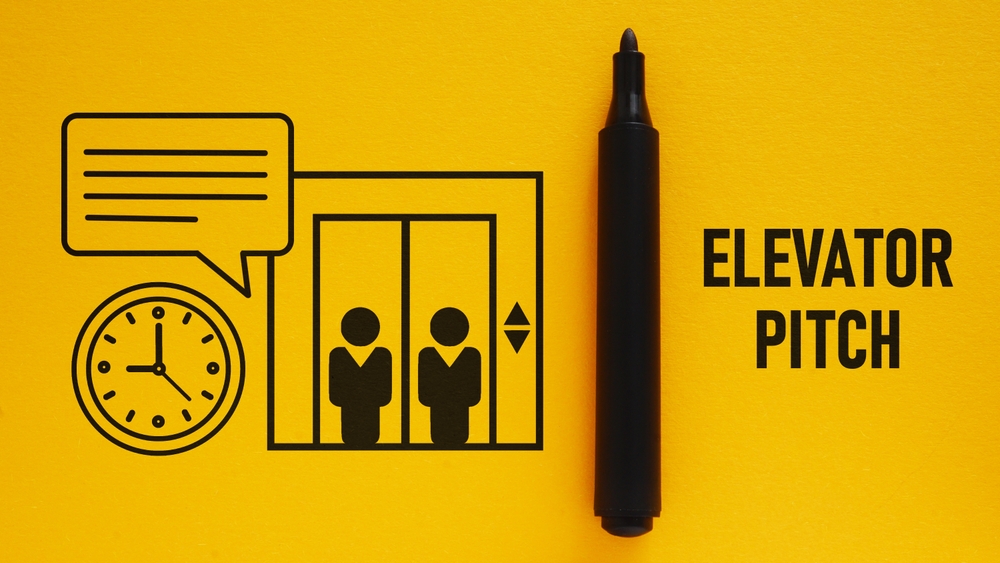
Image: Jack The Sparrow / Shutterstock.
Patience, practice and persistence
Watching outstanding presenters working through their onstage patter and it’s clear that a lot depends on knowing the subject material inside and out. And then there’s their confidence: commanding the space they’re occupying.
For some people, it all comes so very naturally to them. For the rest of us, it requires patience, practice and persistence to hone our communication abilities to a point whereby we’re seen as completely natural, knowledgeable – and composed.
‘It’s about working on the skills that you need to be using subliminally, without needing to think about them.’
‘So whether it’s strong body language, good executive presence, a strong voice or structuring your content, all of those things you should be able to do without thinking.’
‘But then I would really encourage people to use confidence boosting techniques just before that high-stakes moment. So there are so many out there that people can use.’
‘There is visualisation, which Muhammad Ali used and many people in the sports world use, but people use visualisation in business as well.’
Visualisation allows us to rehearse any scenario in our imagination so we know we’ll ‘nail it’ when it comes to delivery in the real world.
‘You could try a mantra, saying a positive mantra to yourself before your high-stakes moment. We also talk a lot at Composure Media about the power pose.’
‘The power pose is a fantastic physical pose that you can take yourself off to the bathroom and do before your high stakes moment.’

Image: ESB Professional / Shutterstock.
Confident body language
It’s an often overlooked point as psychology tells us how our body will respond to how we hold ourselves.
Slumped forward with arched shoulders and we are in a defensive pose. In other words, we have low confidence. But with our head and shoulders back then we can naturally start to feel more relaxed and in control.
‘So those are our favourite ones at Composure Media, but there are so many that that we hear from our clients. So one that we hear quite regularly is people will listen to music.’
‘They will listen, some of them to trance or drum and bass, something quite pumping to get into the right frame of mind. Other people will listen to very calming, soothing, relaxing music.’
‘Something else that we hear from our clients is, and which I subscribe to, is talk to people. So just chat to people because it detracts from how you’re feeling and it stops you internalising your anxieties and also helps your vocal cords get going.’
Talking with people will also allow you to quickly develop a rapport with someone which means you start to feel a natural ‘kinship’ with someone in the audience – and that’s going to act as a confidence booster.
The advent of Artificial Intelligence is allowing the corporate sector to start to use AI presenters for promoting their content.
There are advantages: the AI won’t get nervous or fluff its lines. But there are disadvantages too and the biggest is the loss of the ‘human touch.’
Looking someone in the eyes allows us to connect with them. Looking into the eyes of an AI will never be quite the same. And so, human presentations will remain popular. If well delivered and engaging then they’re entertaining.
I’m spending a lot of free time watching the stand-up comedy routine of Mary Lynn Rajskub who played Chloe O’Brien in the hit drama series, 24. She’s very quick witted and extremely funny. No AI could ever even come close to replicating her humour.
Communicating effectively and authentically
Luisa explains good communication techniques are a real ‘soft skill’ for humans and AI won’t ever be able to replicate our genuine self.
It could be why the corporate world is beginning to invest more and more in developing the public speaking skills of its staff.
‘We know that the best way to communicate is authenticity and no one else can be authentic except yourself. [AI] can’t can help you with your content and it can help you with lots of things but ultimately only you can sound like you.’
‘So communication skills and communicating effectively and authentically especially in the world of business, which is going to be dominated in so many areas by AI, is going to be more important than ever.’
‘But, of course, it’s always been an important skill, being able to communicate well and connect with people and engage with people. And it’s only going to become more important.’
And that neatly brings us to the crux of the interview. What makes a good presentation, well, good. Confidence. Yes. Composure. Yes. Getting the technology right. Yes.
That said, there are some very easy steps we can all take to take something which is already good before ‘lifting it’ towards something which is outstanding. And that means cutting all of the superfluous stuff that people often sandwich into a presentation.

Image: Feel Good Studio / Shutterstock.
‘Stay on track’
Luisa explains it’s crucial to ‘cut the waffle’ and create a structure for your presentation. It’s not a time to ‘wing it.’
She explains you need a framework: a beginning, a middle and an end. Sticking to the structure means there’s less chance of losing your audience.
‘One of the most common mistakes that I hear and see is people are not clear on the core message that they’re trying to communicate.’
‘And in news, you and I would call that the top line, the most important message that we wanted to leave the audience with. And it’s the same in business.’
‘Your audience isn’t going to remember half of what you say, probably. And you will be communicating lots of messages.’
‘But ultimately, you have to be really explicit and emphatic about the one overall core message you want the audience take away with them if they don’t remember anything else.’
The commercial sector is now so competitive that delivering a message quickly and confidently is ‘mission critical’ for the success of any business.
‘In this day and age of digital media where everybody is inundated with information 24-7. Information is abundant – but attention is scarce.’
‘Hook’ the audience from the beginning
‘So it’s more important than ever that we really hook our audiences in right from the beginning and engage them throughout whatever we’re saying.’
‘We’ve always had to work hard in news because we don’t want our audience to switch us off and switch on the competition. So we’ve always worked very hard in news to engage audiences. And it’s exactly the same in the business world.’
‘Confidence is half the battle. So really understanding your confidence, where you’re lacking confidence and how to build your confidence is really the foundation being a good communicator and presenter.’
‘Because without that confidence work, if you just work on the practical skills and your content, you could still crumble in that high-stakes moment.’
This article was originally published on 19 May, 2025.
