
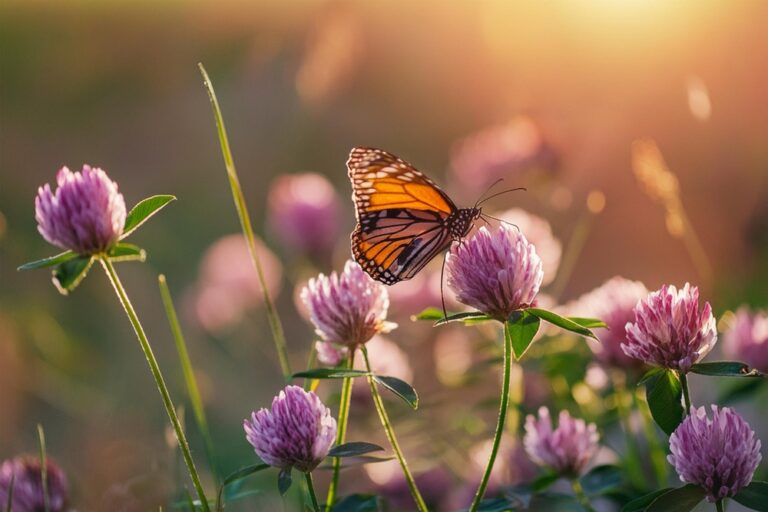
May to September: Grass growing campaign
Environmentalists are encouraging people to avoid cutting the grass over the summer to try to boost the number of butterflies, moths and insects.
The move comes after data shows that 2024 was one of the worst years on record for butterflies in the UK.
It highlighted that more than half of butterfly species in the UK are now in long-term decline. The figures come from the UK Butterfly Monitoring Scheme (UKBMS).
Nine species had their worst year since counting began, including the much-loved Small Tortoiseshell, Chalk Hill Blue and Small Copper.

‘By far the best thing we can do to help butterflies is to create more habitat,’ says Dr Richard Fox, Head of Science at Butterfly Conservation.
‘Last year we published research which showed that letting parts of your garden grow wild with long grass increases the number and variety of butterflies that you see.’
‘That is why we are calling on people and councils across the UK to pledge to not cut their grass this year from April to September: this simple act can make a real, immediate difference to butterflies, moths and other wildlife.’
‘I am devastated by the decline of our beloved British butterflies, and I’m sorry to say it has been brought about by human actions.’
‘We have destroyed wildlife habitats, polluted the environment, used pesticides on an industrial scale and we are changing the climate.’
‘Already-depleted butterfly populations are highly vulnerable’
‘That means that when we have poor weather, these already-depleted butterfly populations are highly vulnerable and can’t bounce back like they once did – and with climate change, that unusual weather is becoming more and more usual.’
Experts say that last year was also the second worst year on record for ‘wider countryside species’ – the common butterflies that live in gardens, parks and across the landscape such as Common Blue, Gatekeeper and Large White.
‘The results revealed by the UK Butterfly Monitoring Scheme highlights why robust wildlife monitoring is absolutely essential for conservation,’ explains Steve Wilkinson, Director of Ecosystem Evidence & Advice at Joint Nature Conservation Committee.
‘Without the dedicated efforts of thousands of volunteers tracking butterfly numbers, we wouldn’t fully understand the scale of this decline.’
‘This comprehensive surveillance allows us to identify which species need urgent intervention, track long-term trends, and measure the effectiveness of our conservation efforts.’
‘The UKBMS data doesn’t just tell us about butterflies – it provides a critical indicator of the health of our wider environment.’
‘In the face of habitat loss and climate change, these monitoring schemes provide the evidence base we need to take meaningful action before it’s too late.’
Overall, 2024 was the fifth worst year since records began for UK butterflies. Experts point out that butterfly numbers always fluctuate annually with last year’s low numbers partly the result of a wet spring and relatively cool summer.
That said the data shows that 31 of the 59 resident UK species are now in long-term decline.
Project monitors more than 3000 sites
The project has asked volunteers to count butterflies across the country since 1976 – and now monitors more than 3,000 sites.
It’s led by Butterfly Conservation along with the UK Centre for Ecology & Hydrology, British Trust for Ornithology and the Joint Nature Conservation Committee. In total, 51 of the UK’s 59 species declined in 2024 compared to 2023.
Among the most concerning species is the Small Tortoiseshell: one of the most well-known butterflies in the UK, its bright colours and appearance in gardens have made it a recognisable favourite.
Since the first UKBMS results in 1976, its abundance has plummeted by 86%. Experts say numbers in 2023 were the worst ever at that point – and last year were down again.
Unlike many of the species that are faring worst, the Small Tortoiseshell is not a rarity confined to nature reserves but a ‘wider countryside species.’ In other words, it lives in all parts of the UK and drinks nectar from a wide variety of flowers. Its caterpillars feed on stinging nettles.
‘We are incredibly grateful to the thousands of skilled volunteers who monitored butterflies last year at more than 3,000 sites as part of the UKBMS, as well the 300 volunteers who are recording both birds and butterflies at the same locations,’ says Dr James Heywood at The British Trust for Ornithology.
‘The collective data, which reveal a concerning picture for so many species, will help to inform lasting, impactful conservation decisions.’
‘We will continue to support and encourage these brilliant citizen scientists to contribute to this scheme and ensure a better future for our amazing British wildlife.’
Significant long-term decline
Of the eight other species that had their worst year on record, Green-veined White, Small Skipper, Large Skipper and Small Copper are also wider countryside species.
The Green-veined White, one of the UK’s most widespread butterflies, is also now in significant long-term decline.
The Grizzled Skipper, Small Pearl-bordered Fritillary and Chalk Hill Blue, which also had their worst year on record, are already listed as threatened on the GB butterfly Red List.
These species all require specific habitat to thrive, and those habitats have been destroyed over the past century.
‘These deeply concerning results from the UKBMS emphasise just how important it is to monitor and record our wildlife so we can target conservation efforts and protect our beloved species,’ says Dr Marc Botham, UK Centre for Ecology & Hydrology.
‘Butterflies in particular are valuable not just in their own right but also as indicator species, meaning they can tell us about the health of the wider environment, which makes the UKBMS data invaluable in assessing the health of our countryside and natural world in general.’
The UKBMS figures come after Butterfly Conservation declared a UK-wide Butterfly Emergency following the worst-ever results of its Big Butterfly Count last year.
‘Most people will not be surprised by these results: all last summer we were inundated with people asking where the butterflies had gone and what they can do to help,’ says Dr Fox.
