
Crew of HMS Medway released turtles as ship heads towards Caribbean
The Royal Navy recently linked up with two marine life organisations to deliver half a dozen loggerhead turtles to warmer waters. The creatures had been washed up on the UK shores before being nurtured back to health.
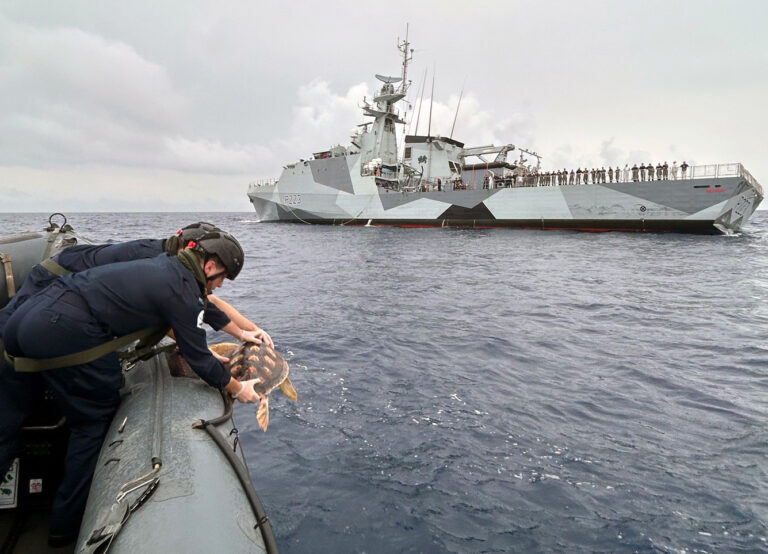
The crew of HMS Medway released the vulnerable creatures off the Azores as the patrol ship heads towards the Caribbean.
HMS Medway sailed from Plymouth last week to relieve her sister ship HMS Trent which has been supporting international counter-drug smuggling operations across the Americas.
The vessel’s also been assisting island communities should they be ravaged by storms during the hurricane season.

The crew took six additional companions with them: Jason, Gordon, Perran, Hayle, Holly and Tonni. The six loggerhead turtles had been cared for by aquariums in Cornwall and Anglesey.
Experts decided that the creatures were sufficiently developed for them to returned to their warm, native waters. And that meant a rather delicate mission.
With HMS Medway due to head to the Caribbean on deployment, the Royal Navy offered to help out.
The creatures were gently dropped into the Atlantic off the Azores, swimming past Medway’s crew who had gathered on the flight deck to watch the repatriation.
‘As professional mariners, many of us are keen to do what we can to reduce the loss of biodiversity at sea,’ says Rod Jones, the Royal Navy’s Senior Maritime Environmental Protection Adviser.
‘Encountering marine wildlife is one of the great joys of seafaring’
‘Encountering marine wildlife is one of the great joys of seafaring and if we can assist, even in a small way, to make that more likely in the future we are pleased to be able to do that.’
‘Assisting turtles to return to warmer waters may not be the Royal Navy’s primary role but as a government body we are very pleased to be able to support the UK’s ambition for more healthy and diverse seas.’
The juvenile turtles were swept from the Caribbean or Eastern Seaboard of the USA by strong winds and Atlantic currents.
Once in the cold waters around they UK they quickly become ‘cold-stunned’ and would have died had they not been washed up and rescued.
Five came ashore in Cornwall and Devon and have been cared for since by staff at Newquay’s Blue Reef Aquarium. The sixth turtle had been nurtured by teams at Anglesey Sea Zoo having been found on one of the island’s beaches.
‘All the turtles arrived in a weakened state – in many cases we were unsure if they were going to make it overnight,’ explains Steve Matchett, group curator for Blue Reef Aquarium.
‘All were dehydrated and emaciated. This is due to being too cold for a long period and being unable to feed / function properly.’
‘Very grateful to the Navy for stepping in to repatriate these rescued turtles.’
‘They have all prospered once we got them past the initial stages. We are very grateful to the Navy for stepping in to repatriate these rescued turtles.’
‘In one way there’s going to be this little bit of you swimming off into the Atlantic,’ says Frankie Hobro, owner of Anglesey Sea Zoo. ‘In another, this is what we have been aiming for since day one. We’re excited and a little bit of emotional in a happy way.’
The zoo’s team has cared for Tonni, since they were washed up next to the aquarium some 20 months ago. Tonni is so-called as it’s Welsh for ‘wave.’
‘She’s in very, very safe hands as well. It’s wonderful to see how enthusiastic and excited they Navy crew are and how keen they are to look after these turtles, it’s lovely.’
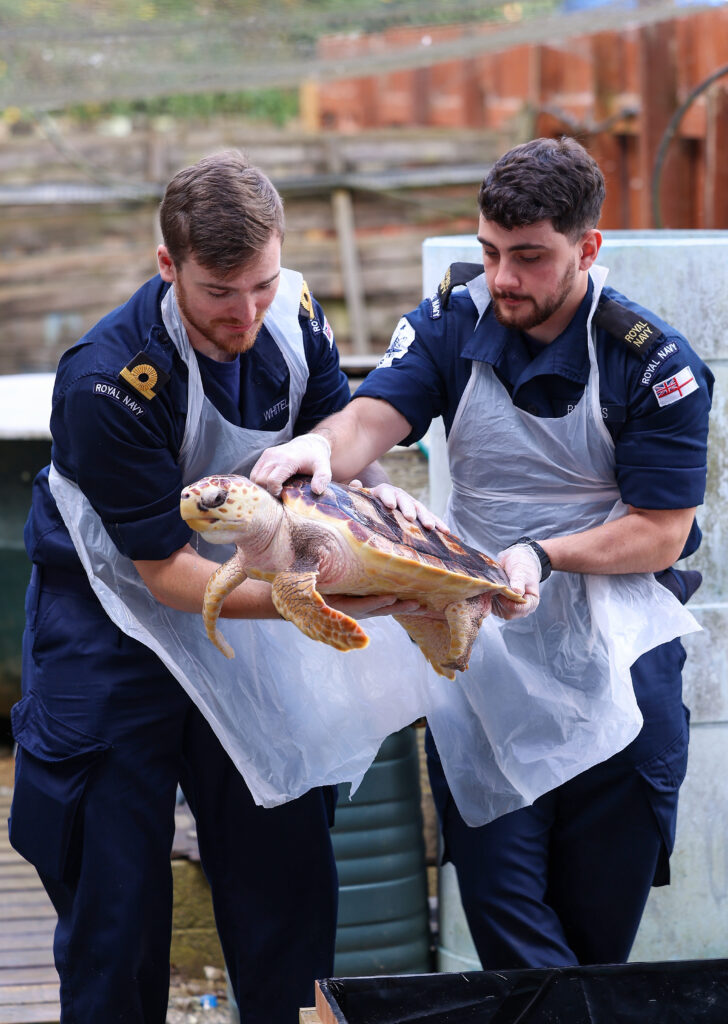
The Blue Reef team showed sailors from HMS Medway how to look after the turtles while aboard the warship.
Although the creatures shouldn’t need feeding their usual fare of marine life such as jellyfish or crustaceans, the team were instructed on how to keep the tanks nice and clean with the water set to an ambient temperature.
Looking after the turtles on board ship
Such was the unusual nature of the job, the RAF carried out a ‘turtle repatriation’ about a decade ago, the two ‘turtle keeper’ posts on board were oversubscribed.
The resulting successful candidates’ names were ‘pulled out of a hat’ with Sub Lieutenant Adam Whitelaw and communications’ specialist Engineering Technician Ryan Brooks taking on the roles.
‘The turtles are surprisingly low maintenance,’ says Ryan.
‘All we really have to do is make sure their cages are clean and the turtles themselves are happy, cosy and moist – that they don’t dry out or suffer sore spots – so that basically means checking in on them twice a day.’
‘This is something we’ve never done before, so definitely something to talk about,’ says Adam. ‘We’ve had some really good, comprehensive training and the aquarium is always available for consulting if we need help.’
‘We don’t envisage any problems – although Gordon, the largest of the turtles, seems a bit of a handful.’
The ship also sailed with its regular cargo of food supplies, spare parts for machinery plus aid kits and disaster relief supplies.
Images provided by the Ministry of Defence show the turtles onboard and being returned to the sea.