
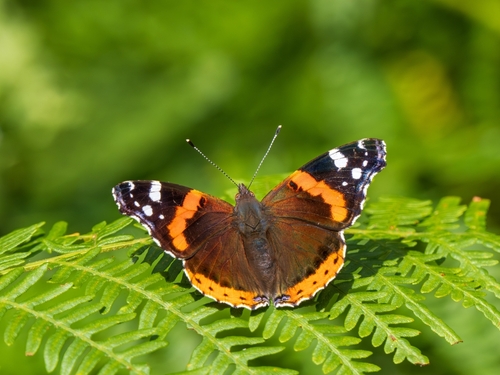
Initial findings for the Big Butterfly Count show decrease in the insect numbers
Leading wildlife charity Butterfly Conservation has revealed very low numbers of butterflies have been spotted so far in their annual Big Butterfly Count.
On average participants are seeing just over half the number of butterflies they were spotting this time last year.
The unusually wet and windy spring, coupled with the colder than usual temperatures so far this summer could be contributing to the lack of butterflies.
Experts say there’s a chance of a later emergence of butterflies if there is a prolonged sunny spell but add that numbers are currently at the lowest level recorded in the 14-year history of Butterfly Conservation’s Big Butterfly Count.

With less than a week remaining of the Big Butterfly Count, scientists are calling on the public to get outside for 15 minutes and record the number and type of butterflies they see – and to enter their results even if they see very few or no butterflies.
They add that doing so will help them to understand more about how butterflies in the UK are faring.
Butterflies ‘need some warm and dry conditions’
‘Butterflies need some warm and dry conditions to be able to fly around and mate,’ says Dr Dan Hoare, Director of Conservation at Butterfly Conservation.
‘If the weather doesn’t allow for this there will be fewer opportunities to breed, and the lack of butterflies now is likely the knock-on effect of our very dreary spring and early summer.’
However, the charity is also warning that it is not only this year’s weather that is contributing to the lack of butterflies being seen.
They point to figures showing that 80% of butterflies in the UK have declined since the 1970s, with habitat loss, climate change and pesticide use the main drivers of this decline.
With populations of butterflies already depleted, they’re less resilient to the impact of poor weather.
‘The lack of butterflies this year is a warning sign to us all. Nature is sounding the alarm and we must listen. Butterflies are a key indicator species,’ says Dr Dan Hoare. ‘When they are in trouble we know the wider environment is in trouble too.’
‘People are telling us that they aren’t seeing butterflies, but simply telling us is not enough, we need everyone to record what they are or aren’t seeing by doing a Big Butterfly Count as this will give us the evidence we need to take vital action to conserve our butterfly species.’
Big Butterfly Count: ‘largest citizen science project of its kind’
Butterfly Conservation’s Big Butterfly Count is the largest citizen-science project of its kind and is a positive action everyone can take to help collect important scientific data which informs policy decision making and conservation effort.
The public are asked to spend just 15 minutes outside when in a sunny spot and record the number and type of butterflies they see.
Whether done with friends and family, or in a moment of quiet and calm solitude, the Big Butterfly Count is free, fun and quick to do. It is open to anyone, of any age, in any part of the UK – towns, cities or the countryside.
No green space is too small – a back garden, a small terrace or balcony with some pot plants, a public park, allotment, or country lane are all important spaces to explore, track and report.
Last year more than 135,000 Big Butterfly Counts took place up and down the country, with participants spending a combined total of almost four years counting butterflies.
The information gathered helps scientists to understand how butterflies and moths and faring, informs conservation projects, government policies, and supports other experts with their research and vital work to protect our planet.
This year’s Big Butterfly Count ends on Sunday 4 August. For more information and to take part simply visit www.bigbutterflycount.org or download the free Big Butterfly Count app.
In separate news, other environmental groups have voiced fears over the impact of invasive Asian hornets for the survival of wasps in the UK.
